
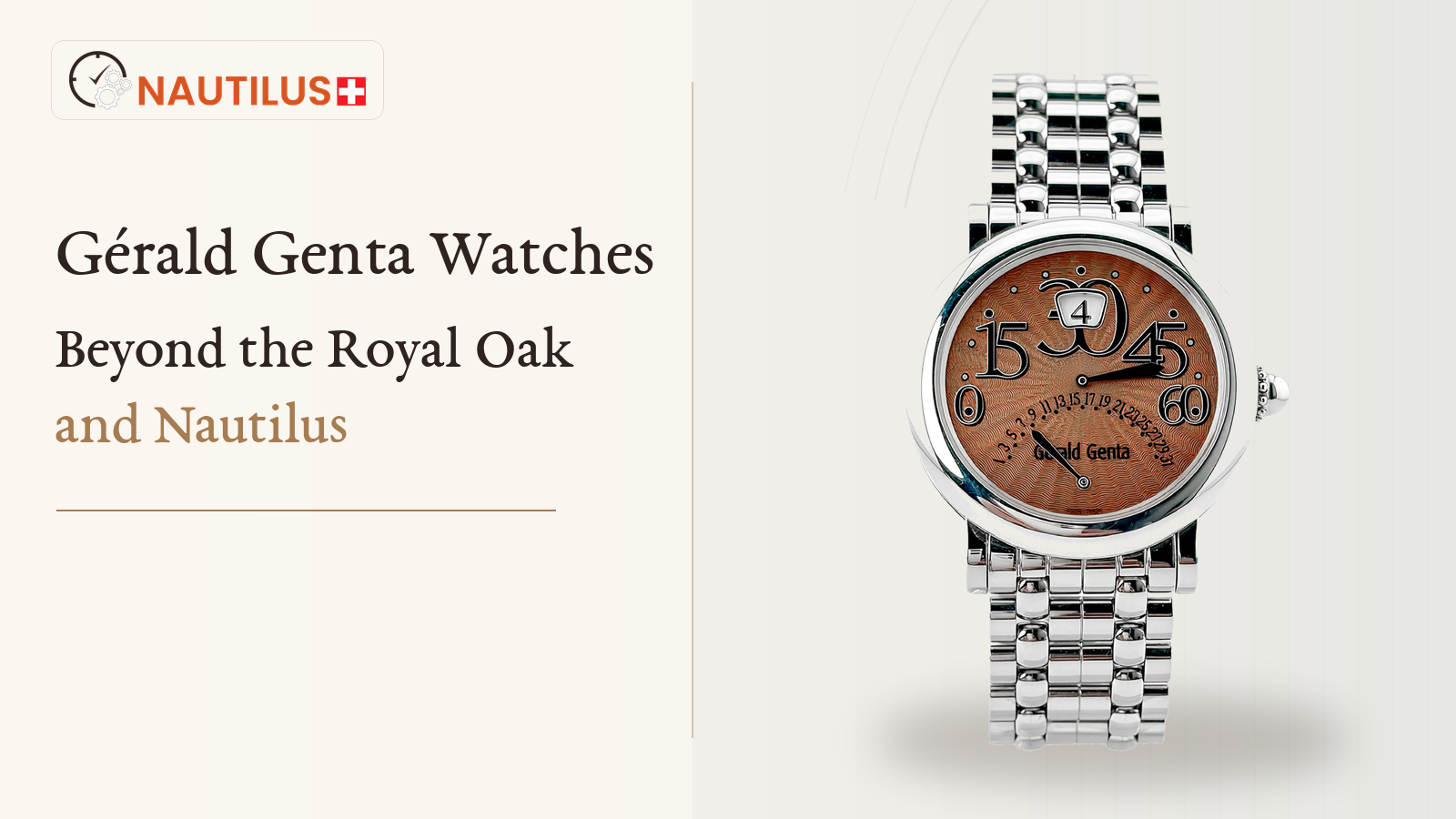
Many watch owners may not realise that Gérald Genta shaped the design of some of the most recognisable watches of the twentieth century. Yet the watches carrying his own name remain comparatively less familiar—and particularly interesting to collectors drawn to unconventional displays, sculptural cases and small-production watchmaking.
At the time of publication, Nautilus Dubai lists a broad selection of Gérald Genta references at our Gold Souk boutique, including Arena Bi-Retro, Biretro, Retro Sport, Sport, Gefica and a wandering-hour piece. This guide explains what makes them distinctive and what to examine before buying one.
The designer behind watches you already recognize
Gérald Genta was born in Geneva in 1931 and trained as a goldsmith and jeweller rather than as a watchmaker. His first widely recognised design, the Universal Genève Polerouter, arrived in 1954 when he was in his early twenties.
The work that followed helped shape the appearance of the modern luxury watch:
Audemars Piguet Royal Oak, 1972: an octagonal bezel, exposed screws and integrated bracelet that helped define the modern luxury steel sports-watch category.
Patek Philippe Nautilus, 1976: a porthole-inspired case with a horizontally grooved dial.
IWC Ingenieur SL, 1976: an integrated-bracelet sports watch with a distinctive five-bore bezel.
Omega Constellation: the sculptural C-shaped case associated with the collection during the 1960s.
Bulgari Bulgari, 1977: a design that placed the brand name prominently around the bezel.
Genta established his own company in 1969 and continued designing for other watch houses alongside it. The Hour Glass acquired Gérald Genta S.A. in 1996. The company later became part of Bvlgari in 2000 and subsequently part of LVMH following the group’s acquisition of Bvlgari. Gérald Genta died in 2011.
Why the watches under his own name are different
Designing for Audemars Piguet or Patek Philippe meant working within the identity and traditions of another watch house. His own brand gave him considerably more creative freedom, and the watches show it.
Where the Royal Oak appears disciplined and architectural, Gérald Genta’s own watches are often playful and unconventional. Cases may be rounded, cushioned or deeply sculpted. Dials are frequently asymmetrical, and time is displayed through jumping hours, retrograde arcs and wandering discs rather than conventional central hands.
Many references appear only infrequently on the secondary market. The brand was also known for highly personalised pieces and special commissions for private clients, which helps explain why relatively few collectors have handled some of these watches in person.
INSERT COLLECTION IMAGE HERE
Alt text: Selection of Gérald Genta watches with jumping-hour and retrograde displays available in Dubai
Jumping hours, retrograde displays and wandering hours explained
Three unusual display principles appear repeatedly across the Gérald Genta collection. Understanding them makes the watches much easier to appreciate.
Jumping hour
Instead of using a conventional hour hand, a rotating disc carries the hour numerals beneath the dial. The current hour appears through an aperture.
At the beginning of each new hour, the disc advances in one immediate step. The hour does not move gradually—it jumps.
The display remains visually calm for most of the hour and then changes decisively. Mechanically, it requires the movement to store and release enough energy to advance the disc cleanly at the correct moment.
Retrograde display
A retrograde hand travels along an arc rather than completing a full circle. When it reaches the end of its scale, it returns rapidly to the starting position and begins again.
Minutes, dates and days of the week are among the indications commonly presented in this way.
The return must be quick, controlled and repeatable without disturbing the operation of the movement. This makes a retrograde mechanism more mechanically demanding than a conventional continuously rotating hand.
Bi-Retro display
Bi-Retro refers to a dial containing two retrograde indications. In Gérald Genta watches, this frequently means retrograde minutes across the upper portion of the dial and a retrograde date below, combined with a jumping-hour aperture.
The result looks entirely different from a conventional watch. Two hands move along separate arcs while the hour changes inside a window. This layout became one of the most recognisable signatures of the Gérald Genta brand.
INSERT JUMPING-HOUR DETAIL IMAGE HERE
Alt text: Close-up of a Gérald Genta Bi-Retro dial showing the jumping-hour window and retrograde displays
The Arena family
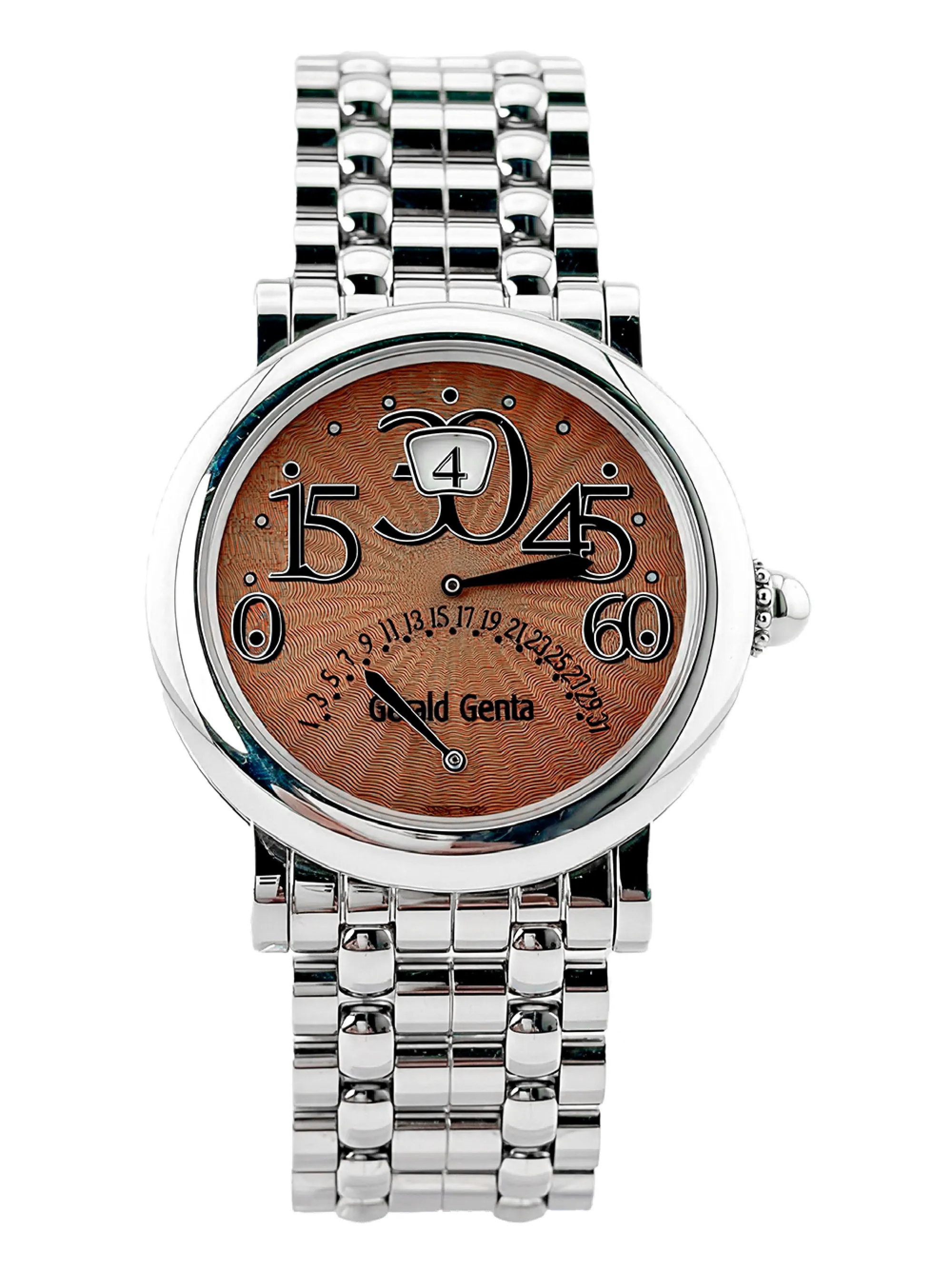
The Arena Bi-Retro expresses Gérald Genta’s signature combination of unconventional display architecture and sculptural case design.
The Arena name is associated with the rounded, generously proportioned case architecture used for many of the brand’s retrograde watches. Its bezel frames the display almost like a stadium surrounding its central arena.
The Arena Bi-Retro combines this sculptural case with a jumping-hour aperture and two retrograde indications. It is one of the clearest expressions of Gérald Genta’s independent design language and one of the families most closely associated with the brand today.
Exact specifications, condition grading, included documentation and availability are confirmed separately for every watch.
Gérald Genta Biretro, Ref. G.3754
The Gefica: a pioneering chapter in bronze watchmaking
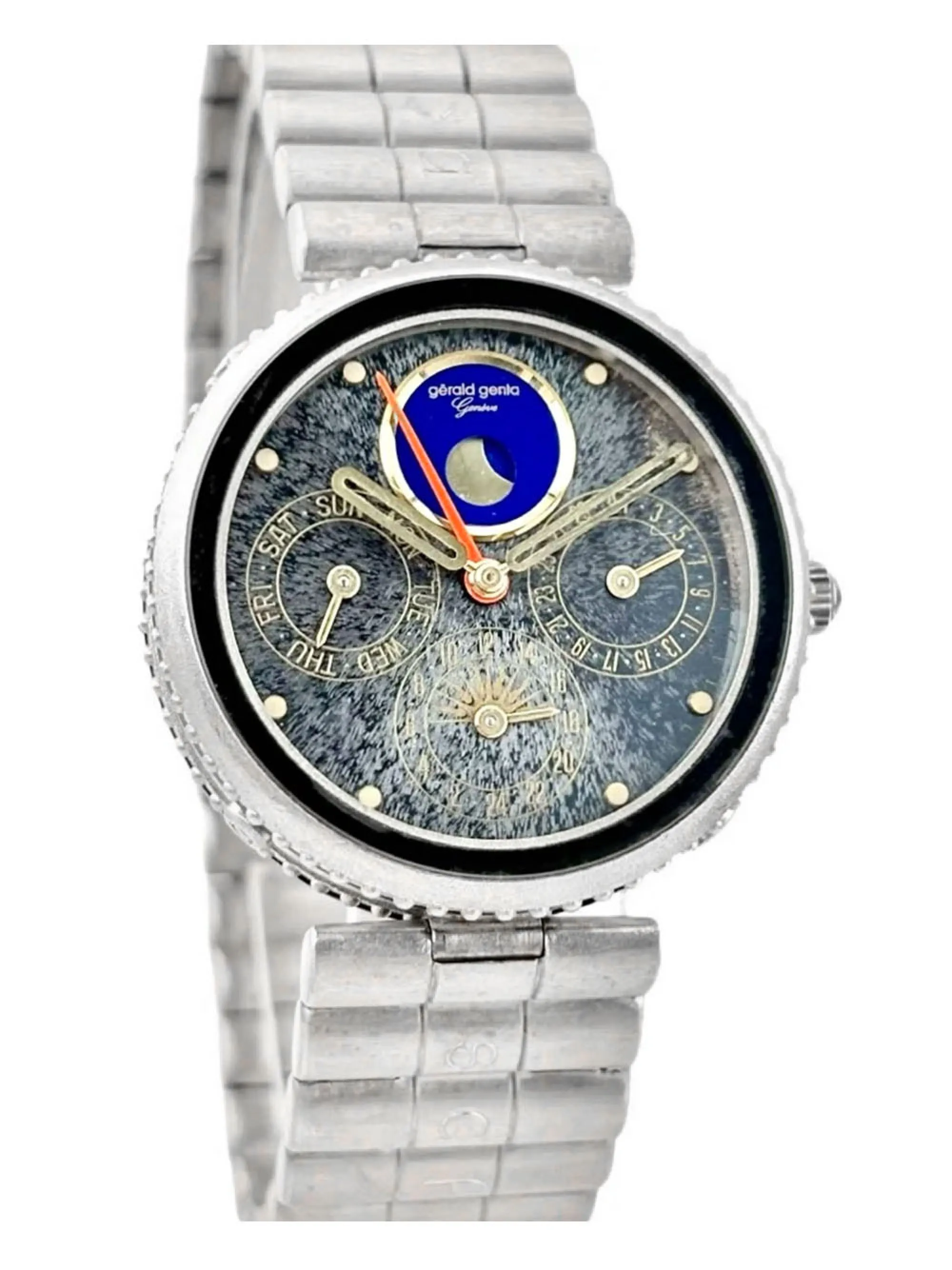
The Gefica is especially notable for its material choice, tactile case construction and distinctive display layout.
The original Gérald Genta Gefica, introduced during the 1980s, is widely credited as a pioneering bronze wristwatch and is frequently described as one of the earliest important wristwatches to use the material.
According to the story commonly associated with the model, bronze was selected for a safari-inspired watch because it reflects less light than highly polished steel. The Gefica name is often attributed to parts of the surnames of three hunters said to have commissioned the original watch, although this account is repeated more frequently than it is independently documented and should therefore be treated as part of the model’s legend.
Bronze also changes visibly with age. It develops a patina influenced by the environment, use and individual wearer, meaning that two bronze watches of the same age may develop very different appearances.
Today, the Gefica is widely discussed as an important early reference point in the history of bronze wristwatches.
However, the Gefica family did not remain limited to bronze. Different versions appeared with varying case materials, movements and complications. Each available watch should therefore be assessed according to its own reference, material, movement, functions and documentation rather than being assumed to share the specification of the original bronze model.
Nautilus Dubai currently lists different interpretations from the wider Gefica family. Their precise materials, movements, functions, condition and included documentation should be confirmed through the individual listings and physical inspection.
View the Gérald Genta Gefica
Retro Sport, Sport and the wandering-hour display
The Retro Sport and Sport families apply Gérald Genta’s unconventional approach in watches designed with regular wear in mind. Depending on the reference, they combine jumping hours, retrograde indications and distinctive case architecture.
The wandering-hour reference presents time differently again. Rotating discs carry the hour numerals across a fixed minute scale. The active hour travels along the scale before moving away and being replaced by the next.
This principle was later explored through a very different visual language by modern independent watchmakers. It is worth comparing with our guide to the URWERK UR-105 CT Streamliner.
Gérald Genta Retro Sport, Ref. RSP.C.10
Gérald Genta Retro Sport Jump Hour
Gérald Genta Sport, Ref. SSP.L.10
Gérald Genta Wandering Hour, Ref. G2705-7
Gérald Genta watch with Persian numerals
Why collectors are returning to Gérald Genta
Several factors are bringing renewed attention to the name.
First, Gérald Genta’s role in the Royal Oak and Nautilus has become more widely understood. As collectors learn about those watches, interest naturally expands towards the designs produced under his own name.
Second, the watches for which he is most famous have become difficult and expensive to acquire. Collectors looking for the same design intelligence are increasingly exploring the watches Genta created without the restrictions of another brand’s established design language.
Third, the maison itself is active again. Revived under LVMH in 2023, Gérald Genta expanded its contemporary Geneva collection at LVMH Watch Week 2026 in Milan with new time-only creations.
This renewed activity brings fresh attention to earlier references and places Genta’s historical design language back into an active modern context rather than treating it as closed history.
What to examine before buying a Gérald Genta watch
Useful next steps: independent watch authentication, restoration assessment, sell a collectible watch.
These watches reward careful physical inspection, particularly because of their unusual complications and specialised components.
Movement and complication function
Jumping-hour and retrograde mechanisms have potential issues that a conventional watch does not. The hour should change cleanly rather than drift gradually between numerals. A retrograde hand should return sharply and land accurately at the beginning of its scale.
These behaviours must be assessed by operating and observing the watch. They cannot be confirmed reliably from photographs alone.
Reference, material and configuration
Several Gérald Genta families appeared in different materials, sizes, movements and dial configurations. Confirm the exact identity of the individual watch rather than relying on general information about the collection.
Originality
Dials, hands, bezels, crowns and other visible components should be reviewed for consistency with the reference. Replacement parts may be difficult to source because of the limited availability of components for some historical models.
Case condition and previous polishing
The sculpted and cushioned cases found throughout the Gérald Genta collection can lose their original character when refinished carelessly.
Where the case is bronze, the existing patina forms part of the watch’s individual history. Removing it without a clear reason may reduce the character that makes the material distinctive.
Where cosmetic work is being considered, our approach to luxury-watch restoration in Dubai begins with physical inspection and restraint.
INSERT CASE-AND-CONDITION IMAGE HERE
Alt text: Gérald Genta watch showing its sculptural case, bracelet and visible condition during inspection
Bracelet, strap and clasp
Integrated bracelets, proprietary straps, end pieces and clasps may be specific to an individual reference. Their condition, size and originality should be checked carefully because replacements may not be interchangeable or readily available.
Documentation and service history
Boxes, papers, certificates and previous service records can provide valuable context, but they should be assessed alongside the watch rather than treated as proof by themselves.
Our inspection-first guide to buying a pre-owned luxury watch in Dubai explains these checks in greater detail.
Nautilus Dubai is an independent specialist. Any view we provide regarding condition, reference consistency or authenticity is an independent specialist opinion based on physical inspection—not a manufacturer-issued certification. Availability, specification and price are confirmed separately for each watch.
View Gérald Genta watches at the Dubai Gold Souk
The Gérald Genta watches described in this guide may be viewed at Nautilus Dubai, Shop 15, One Deira Mall, Gold Souk, Deira. Viewings are arranged by appointment from Monday to Saturday.
Browse our complete collection of luxury watches in Dubai.
If you are searching for a particular Gérald Genta model or reference that is not currently listed, submit your request through our Private Watch Finder.
If you already own a Gérald Genta watch and require an independent assessment, begin with our watch inspection and authentication service.
Nautilus Dubai is an independent luxury-watch specialist and is not affiliated with, endorsed by or authorised by Gérald Genta, Bvlgari, LVMH, Audemars Piguet, Patek Philippe, IWC, Omega or Universal Genève. Brand names and references are used solely to identify and describe the watches presented.