
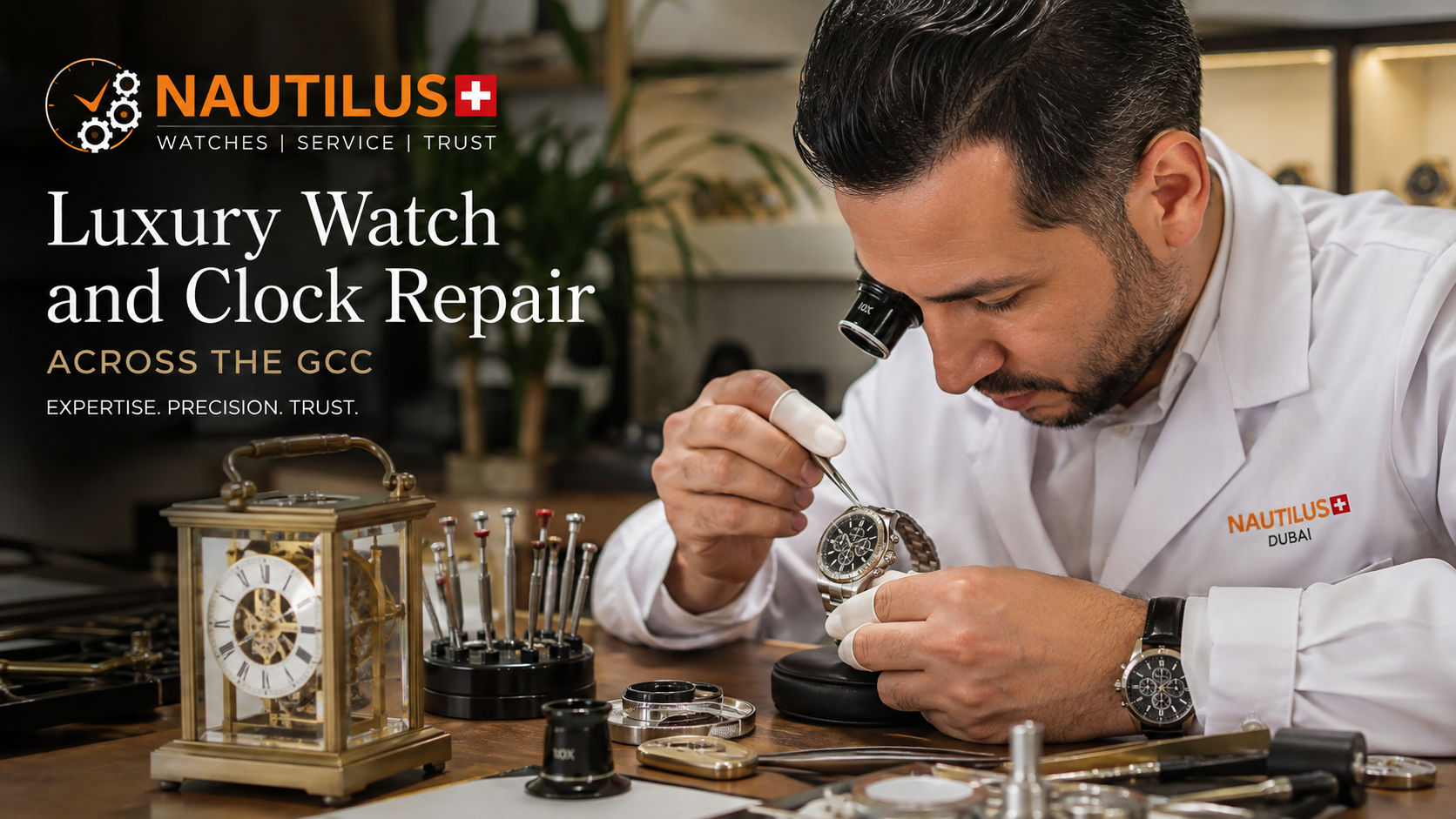
A valuable timepiece does not become less personal simply because it travels across a border. Whether it is a mechanical watch worn every day, a complicated collector’s piece, a quartz watch stored for years or a clock inherited through generations, the owner needs the same things: careful handling, an informed diagnosis and a clear explanation of what should happen next.
Based at Dubai’s Gold Souk, Nautilus Dubai supports watch and clock owners in the UAE and coordinates enquiries from clients across Saudi Arabia, Qatar, Bahrain and Kuwait. Regional collection or delivery arrangements depend on the timepiece, location, insurance, customs requirements and the safest available route.
Our team brings decades of combined practical experience to the assessment of mechanical, automatic and quartz watches, complicated timepieces, vintage pieces and clocks. That experience matters because responsible horological repair begins long before a component is replaced or a movement is opened.
Regional expertise starts with the individual timepiece
There is no single repair process that is suitable for every watch or clock.
A modern automatic sports watch, a vintage hand-wound dress watch, a quartz chronograph and a mechanical clock may all display the wrong time, but the cause, diagnostic method, parts requirement and appropriate intervention can be entirely different.
Experienced assessment means understanding:
The construction and age of the movement
The functions and complications involved
The condition of the case, dial, hands, crown, bracelet or clock housing
Previous repair or restoration work
Availability and compatibility of replacement components
The owner’s objective: reliable use, conservation, restoration or preparation for sale
Whether intervention may affect historical originality or collector value
This is why our process is led by the reference, symptoms and physical condition of the specific timepiece rather than by a generic price list.
What an experienced repair team examines first
Before recommending repair, servicing or restoration, the team first builds a clear picture of the timepiece and the problem.
Useful information includes the brand, model, reference number, approximate age, recent service history and a description of what has changed. Photographs can help prepare the enquiry, but they do not replace physical inspection.
During inspection, the review may include:
External condition and signs of impact or moisture
Crown, pushers, correctors and setting functions
Timekeeping behaviour and power reserve
Calendar, chronograph, alarm or other complication operation
Battery, coil and electrical consumption on quartz watches
Bracelet, strap, clasp, spring bars and attachment points
Visible corrosion, previous polishing or unsuitable repairs
Clock movement, winding system, pendulum, strike or chime behaviour
Availability of original, compatible or appropriate replacement parts
Only after this stage can the team explain whether the timepiece needs adjustment, cleaning, component replacement, movement service, restoration or no immediate intervention.
Mechanical and automatic watch repair
Mechanical watches depend on the controlled interaction of the mainspring, wheel train, escapement, regulating organ and carefully placed lubricants.
A watch may continue running even when its performance is deteriorating. Common signs include:
A noticeable change in daily accuracy
Reduced power reserve
Irregular winding resistance
A rotor that sounds or feels different
A date that changes slowly or at the wrong time
A chronograph that hesitates or fails to reset correctly
A watch that stops in certain positions
These symptoms should not be diagnosed by guesswork. The same visible problem may have several possible causes, from magnetism or impact to dried lubricant, wear, contamination or a damaged component.
Our luxury watch repair service begins with inspection so that the recommended work reflects the actual movement rather than assumptions based only on the brand.
Quartz watch diagnostics
Quartz watches are sometimes treated as simple because they use a battery, but battery replacement is only one possible requirement.
A stopped or inaccurate quartz watch may involve:
A depleted or leaking battery
Excessive current consumption
Coil or circuit failure
Gear-train contamination
Moisture ingress
Damaged contacts
A mechanical obstruction within the calendar or hands
Installing a new battery without checking the condition of the old cell and the movement can leave the underlying problem unresolved.
A leaking battery should be addressed promptly because corrosion can spread beyond the battery compartment and damage components that are far more difficult to replace.
Complicated, rare and vintage watches
Chronographs, annual and perpetual calendars, alarms, moon phases, GMT mechanisms, jumping-hour displays and modular complications require a different level of diagnosis from a basic three-hand watch.
Vintage and discontinued watches introduce additional questions:
Are the visible components consistent with the reference?
Has the case been heavily polished?
Is the dial original, restored or replaced?
Are older service parts present?
Can a worn part be sourced without compromising the watch?
Would cosmetic restoration improve the piece or remove valuable history?
The most experienced decision is not always the most extensive intervention.
For certain collector’s watches, preserving original geometry, patina and period components may be more important than making the watch appear new. Our approach to luxury-watch restoration therefore begins with restraint and an understanding of the owner’s objective.
Clock repair requires a different discipline
A clock is not simply a larger wristwatch.
Its movement may be weight-driven or spring-driven and may include a pendulum, striking train, chime mechanism, calendar or musical function. The case may also contain wood, glass, metal, paint, decorative finishes and historically important components.
Clock assessment can involve:
Whether the movement winds and releases power correctly
Escapement and pendulum behaviour
Worn pivots, bearings and wheel teeth
Strike and chime sequencing
Hands, dial and setting mechanisms
Movement security inside the case
Case condition and previous structural repairs
Environmental exposure to dust, heat or humidity
Damage caused during relocation or transport
Incorrect cleaning or casual lubrication can make a clock worse rather than better. Conservation guidance also warns that historic clocks may contain fragile materials and that inexperienced cleaning can damage working components.
For this reason, owners should not spray lubricant into a clock, force a key, move the hands against resistance or transport a pendulum clock without first asking how it should be secured.
Clock enquiries can be started through our services team with photographs of the complete clock, dial, movement where safely accessible, dimensions and a description of the problem.
Why GCC conditions matter
The GCC places watches and clocks in a demanding environment.
Heat, humidity, air-conditioning, fine sand, perspiration, salt water and rapid temperature changes can affect seals, straps, bracelets, batteries, lubricants and decorative clock cases.
For watches, water resistance is verified through defined tests; it is not a permanent promise that remains unchanged regardless of age, wear or gasket condition. ISO 22810 specifies requirements and test methods for water-resistant watches.
After sea or beach exposure, manufacturers advise rinsing an appropriately water-resistant watch with fresh water to remove salt and sand, while ensuring the crown is correctly secured.
For clocks, uncontrolled humidity can affect metal, wood, leather, paint and other organic or decorative materials. Changes in humidity can contribute to corrosion, mould, distortion and cracking depending on the materials involved.
Practical GCC precautions include:
Never leave a watch in a parked car
Keep watches and clocks away from direct sunlight
Rinse suitable water-resistant watches after sea exposure
Wipe perspiration from cases, bracelets and clasps
Do not store leather straps while damp
Avoid placing clocks directly under strong air-conditioning vents
Keep fine sand away from crowns, pushers, bezels and clock mechanisms
Have any condensation or visible corrosion inspected promptly
Repair, restoration and preservation are not the same
Repair aims to return a failed function to proper operation.
Servicing generally involves cleaning, inspection, lubrication, adjustment and replacement of worn components where required.
Restoration may address visible damage, corrosion, case condition, dial elements, missing parts or previous unsuitable work.
Preservation may require doing less.
A skilled specialist should explain which of these approaches is appropriate and why. Polishing every case, replacing every aged component or removing every sign of time is not automatically the best outcome.
For an inherited clock or a rare vintage watch, signs of age may form part of its identity. Any proposal should balance function, appearance, originality and long-term preservation.
Parts and discontinued components
Parts availability is frequently the most difficult part of repairing an older watch or clock.
Compatibility may depend on:
Exact reference or calibre
Production generation
Case or dial configuration
Movement modification
Dimensions and tolerances
Whether the available component is original, service replacement or compatible
Whether fitting the part requires additional adjustment
The team should never promise a component based only on a general model name. Use our watch spare-parts service or parts request with the clearest available reference and photographs.
Coordinating a repair from another GCC country
For owners outside Dubai, the first stage can begin remotely.
Send:
Your name and country
Watch or clock brand
Model and reference number
Approximate age
Clear photographs
Description of the symptom
Previous repair or service information
Whether the item has box, papers or special accessories
Any deadline or travel date
The team can then advise whether an appointment, collection, delivery or another inspection route may be appropriate.
Do not ship a valuable timepiece before the route has been confirmed. Packaging, declared value, insurance, customs, batteries, pendulums, weights and delicate clock cases may require different handling.
Collection and delivery are arranged only where available and after the concierge confirms the practical and security requirements. Learn more through our pickup and delivery service.
Signs that should not be ignored
Contact a specialist when you notice:
Condensation beneath the crystal
Sudden or significant loss of accuracy
Reduced power reserve
A crown or pusher that feels loose, rough or different
A chronograph that will not start, stop or reset correctly
A stopped quartz watch with an old battery inside
Corrosion around the clasp, caseback or battery compartment
A clock that stops repeatedly despite correct winding
A pendulum that no longer swings evenly
Strike or chime sequences occurring at the wrong time
A timepiece that has suffered an impact or fall
Continuing to operate a damaged mechanism can turn a limited repair into a larger restoration.
Why inspection comes before quotation
Photographs and descriptions are useful for preparing an enquiry, but they cannot confirm internal wear, parts compatibility, movement condition or the full extent of earlier work.
Nautilus Dubai does not confirm a final repair price or completion time before physical inspection.
This approach protects the owner from an unrealistic promise and allows the specialist to explain:
What has been observed
What testing is still required
Which work is recommended
Which work is optional
What parts may be needed
What risks or limitations exist
What should be preserved
Regional trust is built through this kind of transparent process—not through a “number one” slogan.
Start your watch or clock repair enquiry
Nautilus Dubai is based at Shop 15, One Deira Mall, Gold Souk, Deira, Dubai, and is open Monday to Saturday.
Begin with the Repair Doctor, contact the concierge, or book an appointment.
Clients outside Dubai should share their country and timepiece details before arranging transport.
Nautilus Dubai is an independent luxury watch and clock specialist. It is not affiliated with, endorsed by or authorised by the watch brands referred to on this website. Brand names are used only to identify and describe the timepieces concerned.
[Clock Repair in Dubai](/services/clock-repair-dubai)