
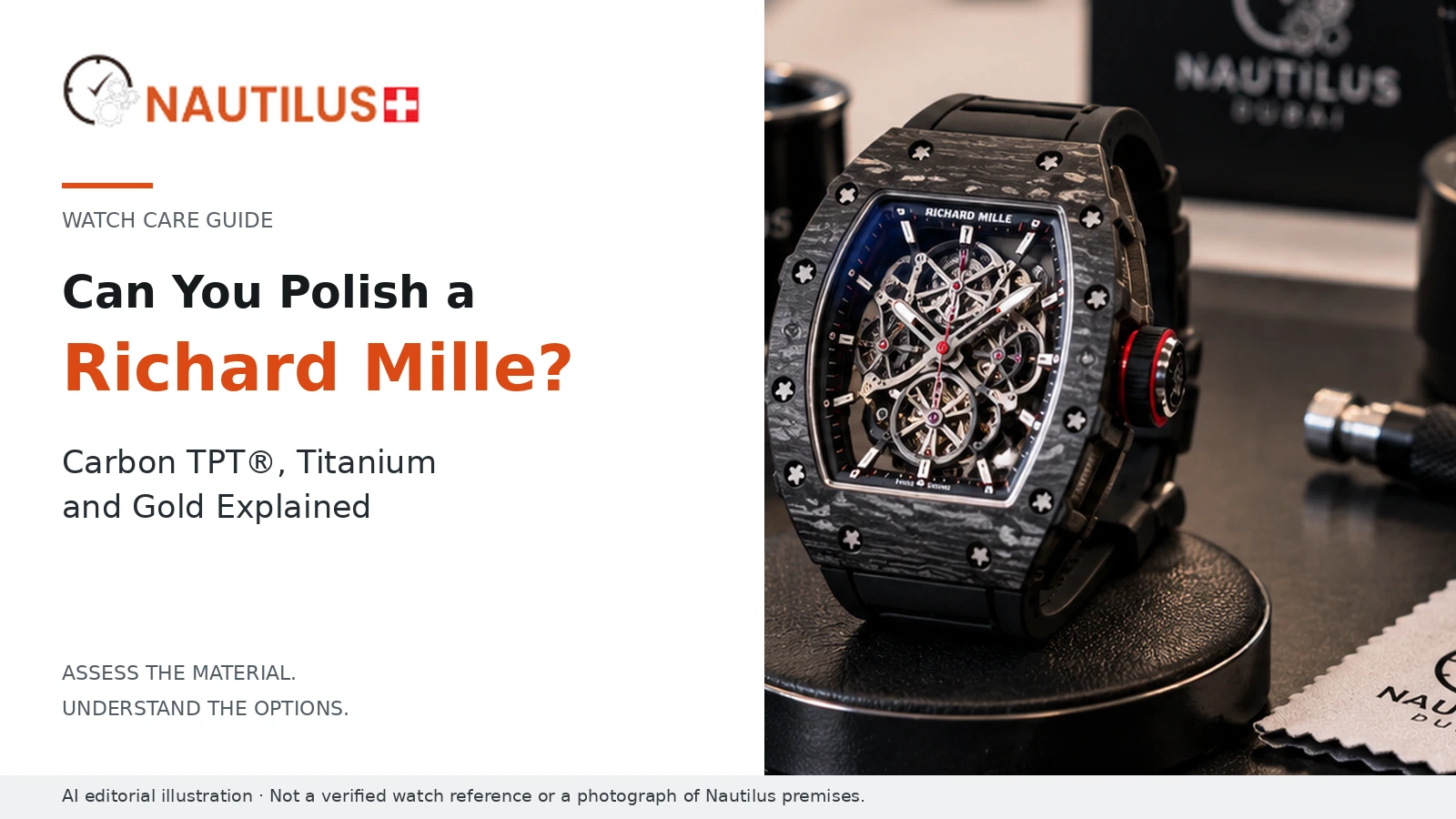
A mark on a Richard Mille case can prompt an immediate request: “Can you polish it out?” Before approving that work, ask a more useful question: what is the affected component made from, and which finish should it have?
Some cases may be suitable for carefully assessed refinishing, but there is no universal polishing treatment for the whole collection. Richard Mille distinguishes solid-metal components from coated parts and specialised non-metallic materials in its own after-sales guidance. [1]
For an owner in Dubai, the right starting point is a reference-specific assessment—not a promise that every scratch will disappear.
First, define what you want to change
Ask the specialist to distinguish cleaning from polishing and broader refinishing. Cleaning addresses unwanted surface contamination; abrasive polishing removes material. The latter is not a harmless trial treatment to use while deciding what a mark is. [7]
Be precise about the intended result. Do you want dirt removed, a visible scratch assessed, or the case's original appearance reviewed? “Make it shiny” is a poor instruction when you have not established which surfaces should be reflective and which should retain another finish.
Before any work, request photographs of the affected area and a written description of the proposed scope. Treat your preference to leave a surface untouched as a valid instruction, not a failure to maintain the watch.
Carbon TPT®: do not start with a metal-polishing solution
Carbon TPT® has a layered composite structure; its characteristic patterns emerge during machining and finishing. It is not simply black-coloured metal. [3]
The distinction matters when discussing a scratch. Richard Mille states that deep damage to composite components can require replacement. [1] Do not convert that into either “all carbon marks are repairable” or “every mark means a new case”.
Instead, ask which component is affected, what the assessment can establish and what options are available for that exact reference. Request an explanation of what might remain visible. Avoid polishing paste, abrasive cloths and attempts to rub a questionable mark away before it has been assessed.
A useful enquiry is: “There is a mark on this Carbon TPT® component. Please assess it and explain the appropriate options before any cosmetic treatment.”
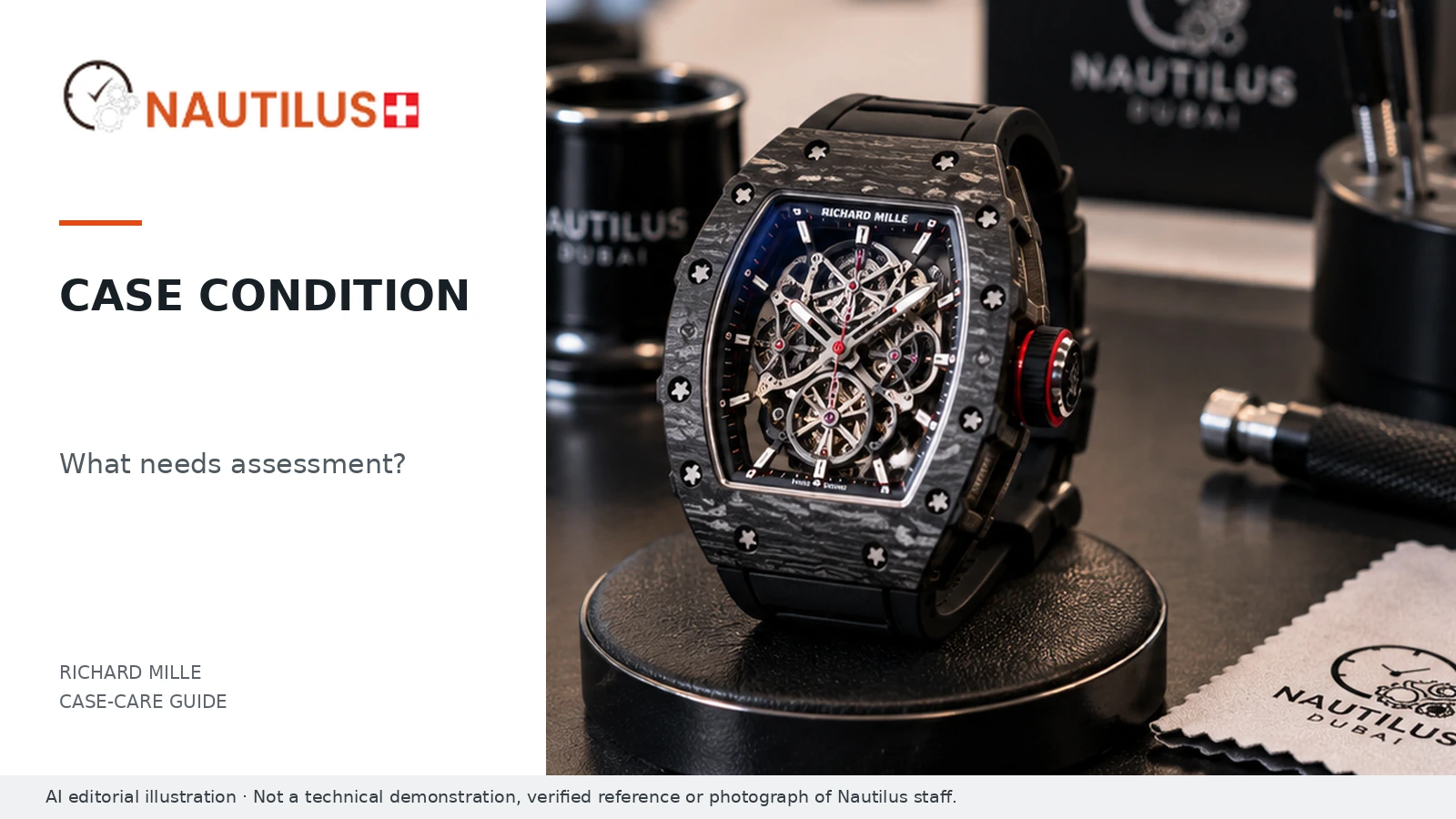
Case material and the affected area should be assessed before discussing cosmetic work. AI-generated editorial illustration. Not a technical demonstration, verified Richard Mille reference, or photograph of Nautilus staff or premises.
Titanium: identify the finish, not just the metal
Titanium is not a complete description of a case finish. For example, Richard Mille describes a satin-finished and polished grade 5 titanium bezel beneath a Carbon TPT® bezel on the RM 65-01 McLaren W1. That construction belongs to this reference; it is not a specification for every model. [4]
For your watch, ask the assessor to identify the existing finish around the mark, the boundaries between different surfaces and any relevant prior work. Do not approve an all-over gloss finish simply because it might look brighter in a photograph.
Make preservation of the intended appearance part of the brief. Ask how the proposed work will address the affected area and which surfaces will remain untouched. A clear explanation is more useful than the unspecific reassurance that “titanium can be polished”.
Gold: confirm whether the component is solid metal
A gold appearance is not enough to select a treatment. Richard Mille also makes Gold Carbon TPT®, which combines carbon layers with gold leaf. This is different from a conventional solid-gold component. [5]
For a gold case, establish the material of the particular part, its finish and whether it carries gem-setting or a surface treatment. Richard Mille identifies gem-set cases as requiring additional care during refinishing. [1]
Ask the provider to distinguish proposed cosmetic work from any replacement recommendation. Do not approve the removal of every visible mark as an open-ended instruction, and keep the original condition record with the completed-work documentation.
Three decisions to discuss after assessment
Leave the finish unchanged. Ask whether the concern is cosmetic and whether doing nothing is a reasonable option. You do not have to commission cosmetic work simply because you booked an assessment.
Approve a clearly defined treatment. Request the exact component, intended result, limitations and consent required for disassembly. Avoid vague approval for a whole-case “refresh”.
Seek a replacement or manufacturer-route assessment. Ask what evidence supports that recommendation, who would perform the work and which costs or timings remain unconfirmed. These are discussion routes, not promised outcomes for an unseen watch.
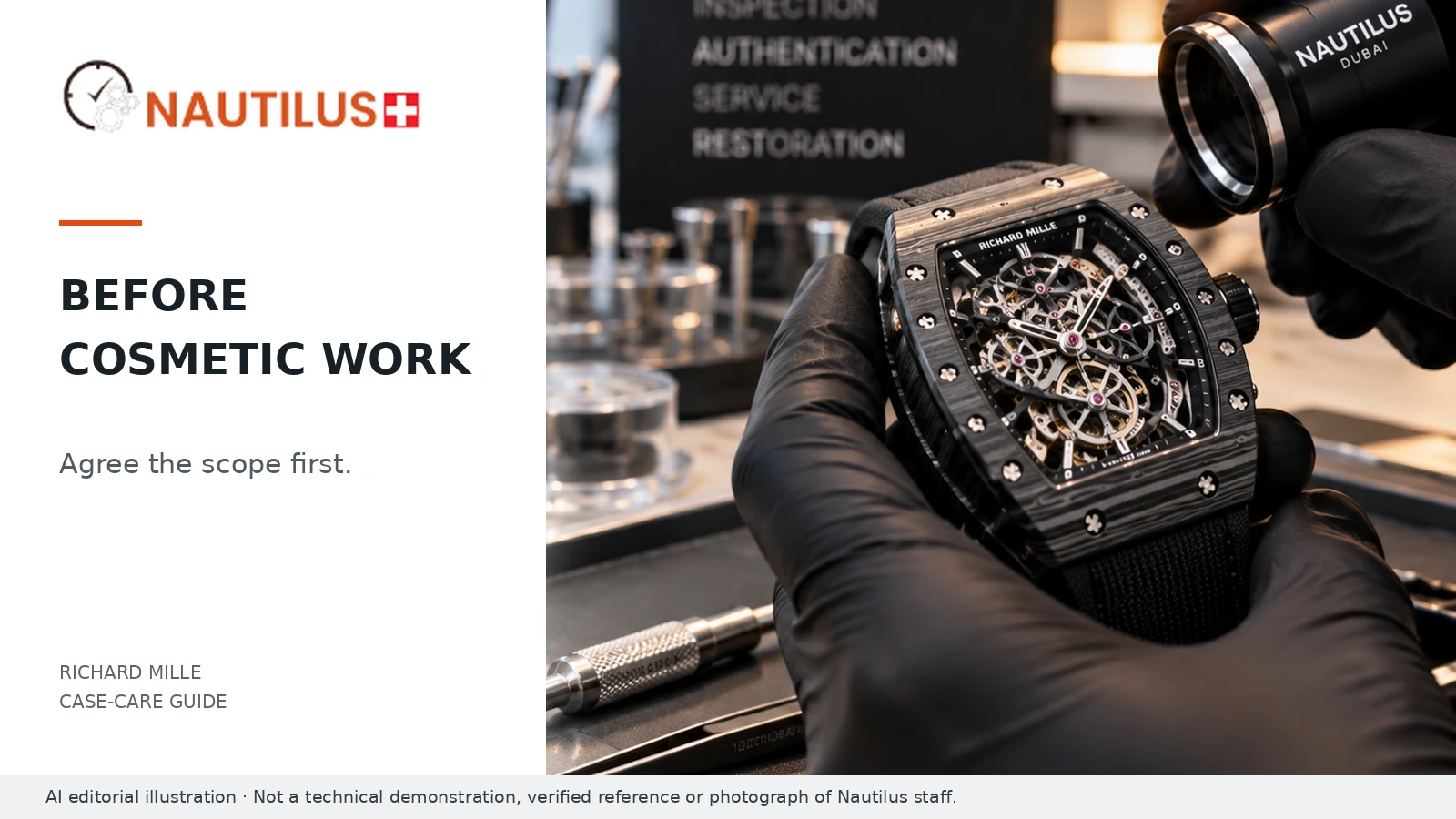
Agree the assessed scope and limitations before authorising cosmetic work. AI-generated editorial illustration. Not a technical demonstration, verified Richard Mille reference, or photograph of Nautilus staff or premises.
What should a quotation explain?
Request an itemised description of the work, not just a polishing price. Establish whether assessment charges are separate, whether parts are needed, who will carry out the intervention, and how additional work would be authorised.
Also discuss how the result will be documented. Ask for a record of the treated surfaces, any remaining visible marks and any checks appropriate to the work actually undertaken. Keep cosmetic approval separate from permission for unrelated mechanical servicing.
Check manufacturer warranty before authorising intervention
Richard Mille states that work outside its network voids its manufacturer warranty. [6] When retaining that coverage matters, consult the authorised network before agreeing to intervention elsewhere. Independent workmanship terms are not the same as the brand's warranty.
Discuss your case concern with Nautilus Dubai
Send your reference, a description of the mark and any known cosmetic-service history through our Richard Mille service enquiry page. Photographs can help explain your concern; they are not a substitute for physical assessment or a basis for guaranteeing scratch removal.
Nautilus is an independent luxury watch specialist in Dubai's Deira Gold Souk, with final quotations subject to physical inspection. It is not an authorised Richard Mille service centre. [8]
The goal is an informed decision about your watch's condition—not simply a shinier case.